

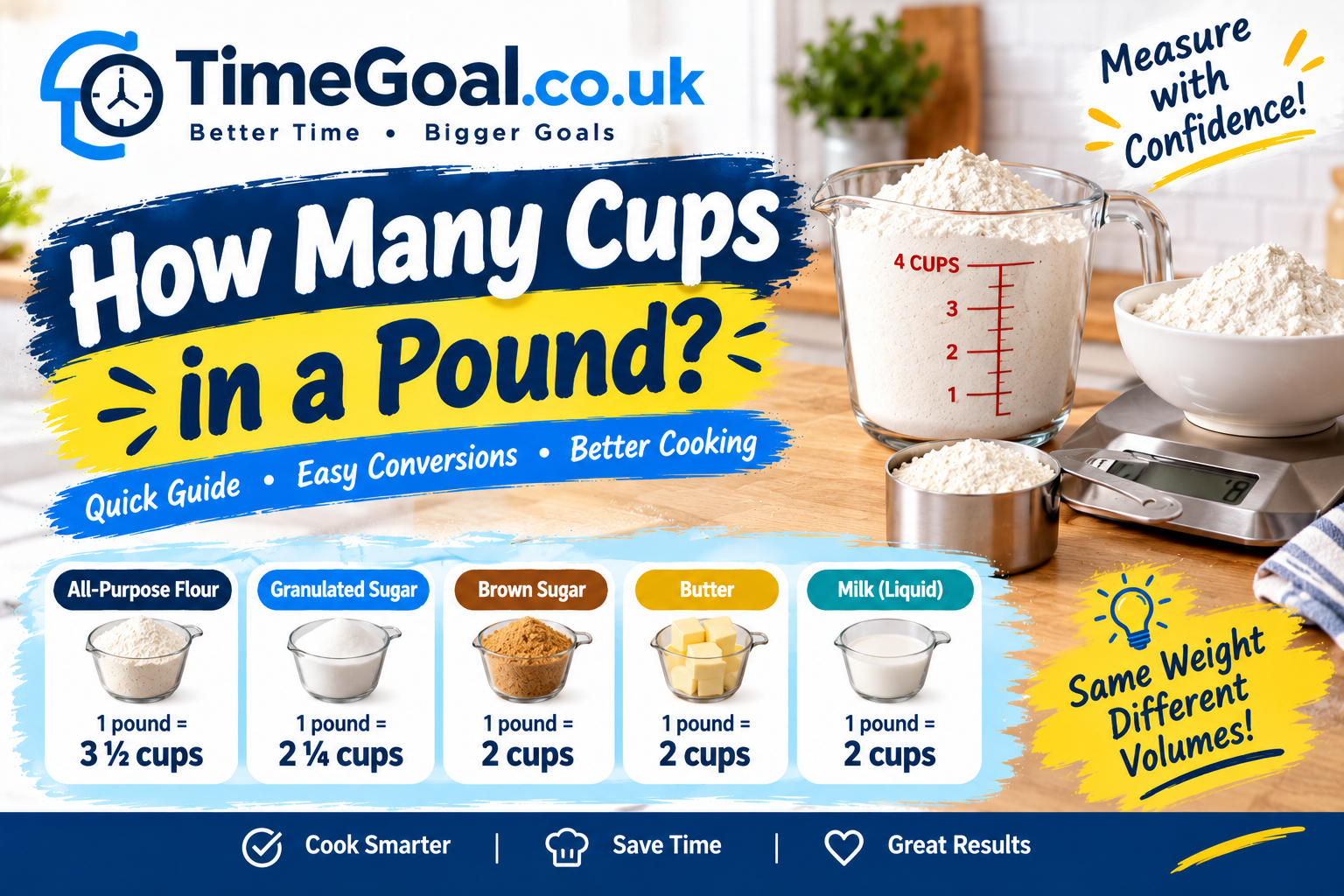
Knowing how many cups in a pound is essential for anyone who enjoys cooking, baking or preparing meals at home. Whether you are following a traditional family recipe, making a cake or measuring ingredients for a large meal, understanding the relationship between cups and pounds can help you achieve better results. However, the answer is not always straightforward because different ingredients have different weights and volumes.
A pound measures weight, whereas a cup measures volume. This means that one pound of flour will occupy a different number of cups than one pound of sugar, butter or rice. Understanding this difference is the key to converting measurements accurately and avoiding common kitchen mistakes.
In this comprehensive guide, you will discover how many cups are in a pound, how the conversion varies by ingredient, and which measuring methods work best for cooking and baking.
How Many Cups in a Pound?
There is no single answer to how many cups are in a pound because the conversion depends on the ingredient being measured. A cup of flour weighs less than a cup of granulated sugar, even though both ingredients occupy the same volume.
In the United States customary measurement system, one pound equals 16 ounces by weight. A standard US cup holds eight US fluid ounces by volume, but this does not mean that every pound contains two cups of every ingredient.
For example, a pound of water is approximately two US cups because water has a density that makes its weight and volume relatively easy to compare. Dry ingredients, however, vary considerably in density.
Why Cups and Pounds Are Different Measurements
Cups and pounds measure two different properties.
- Cups: Measure volume, or the amount of space an ingredient occupies.
- Pounds: Measure weight, or how heavy an ingredient is.
- Ounces: Can measure weight or fluid volume, depending on the measurement system being used.
This distinction matters when following recipes. Flour can become compacted inside a measuring cup, while brown sugar may be packed tightly to remove air pockets. Both situations change how much an ingredient weighs in a cup.
Quick Conversion Guide
The following table provides approximate US cup conversions for common kitchen ingredients.
| Ingredient | Approximate cups per pound |
|---|---|
| Water | 2 cups |
| Whole milk | 1.9 cups |
| All-purpose flour | 3.6 cups |
| Bread flour | 3.5 cups |
| Granulated sugar | 2.25 cups |
| Brown sugar, packed | 2.25 cups |
| Icing sugar | 3.75 to 4 cups |
| Butter | 2 cups |
| Uncooked white rice | 2.25 to 2.5 cups |
| Rolled oats | 4.5 to 5 cups |
| Honey | Approximately 1.3 cups |
These figures are estimates rather than universal measurements. The exact conversion can vary according to the ingredient’s brand, moisture content, packing method and particle size.
How Many Cups in a Pound of Flour?
Flour is one of the most frequently measured ingredients in baking. However, it is also one of the easiest ingredients to measure incorrectly.
One pound of all-purpose flour generally equals approximately 3.5 to 3.75 US cups when measured using a typical spoon-and-level method. Many recipes use a working estimate of 3.6 cups per pound.
Why Flour Measurements Vary
Flour contains air between its particles. If you scoop flour directly from a bag, you may compress it and collect more flour than intended. Sifting also changes its volume by introducing air between the particles.
For this reason, two cups of flour may not weigh exactly the same amount when measured differently.
Best Method for Measuring Flour
For reliable baking results, use digital kitchen scales whenever possible. Measure the required weight rather than relying entirely on cups.
If you do not have scales, gently spoon the flour into a dry measuring cup and level the top with a straight edge. Avoid shaking, tapping or pressing the cup.
How Many Cups in a Pound of Sugar?
Sugar generally occupies less volume per pound than flour because granulated sugar is denser.
One pound of granulated white sugar is approximately 2.25 US cups. This makes sugar relatively easy to convert when following recipes that provide measurements in pounds.
Granulated Sugar
Granulated sugar consists of small crystals that settle into a measuring cup. A standard US cup typically weighs around 200 grams, although the exact figure can vary.
For recipes requiring one pound of sugar, approximately 2.25 cups is a useful starting point.
Brown Sugar
Brown sugar contains molasses, which gives it moisture and a softer texture. Recipes commonly instruct cooks to pack brown sugar firmly into a measuring cup.
One pound of packed brown sugar is approximately 2.25 cups, but the result depends on how firmly it is packed.
Icing Sugar
Icing sugar, also known as powdered sugar or confectioners’ sugar, is much lighter and finer than granulated sugar.
One pound generally measures around 3.5 to 4 cups, depending on whether it has been sifted and how it is handled.
How Many Cups in a Pound of Butter?
Butter is comparatively simple to convert because it is sold in standardised blocks or sticks in many countries.
One pound of butter equals two US cups, or approximately 454 grams. In the United States, this is equivalent to four standard sticks of butter.
Measuring Butter Without Scales
If your butter packaging displays weight markings, use them to cut the amount you need. Some butter wrappers include tablespoon or cup measurements, making portioning easier.
For recipes requiring one-half pound of butter, use approximately one US cup. For one-quarter pound, use approximately one-half US cup.
Remember that butter should be measured according to the state specified in the recipe. Melted butter and solid butter can behave differently when incorporated into mixtures, even when their weight is identical.
How Many Cups in a Pound of Rice and Oats?
Dry grains and cereals vary in size and density, so their conversions differ from those of flour and sugar.
Uncooked Rice
One pound of uncooked white rice generally measures around 2.25 to 2.5 US cups. Long-grain rice, short-grain rice and other varieties may have slightly different volumes.
Rice expands during cooking because it absorbs water. However, this expansion does not change the original weight of the dry rice in the same way that adding extra ingredients would.
When preparing rice for a specific number of people, follow the recipe’s dry-rice measurement rather than estimating the cooked volume.
Rolled Oats
Rolled oats are light and contain considerable air between the flakes. One pound can measure approximately 4.5 to 5 US cups.
The exact quantity depends on the size and thickness of the oats. Quick oats, rolled oats and steel-cut oats have different shapes and densities, so their cup measurements should not be treated as interchangeable.
How Many Cups in a Pound of Liquid Ingredients?
Liquid ingredients can sometimes be converted more easily than dry ingredients, but their densities still matter.
Water
One pound of water is approximately 1.92 US cups at ordinary kitchen temperatures. For everyday cooking, this is often rounded to two cups.
The small difference results from the fact that a US cup is a volume measurement, while a pound is a unit of mass.
Milk
Milk is slightly denser than water. One pound of whole milk is approximately 1.9 US cups.
Milk’s fat content and composition can affect the precise conversion, although the difference is usually small enough for ordinary cooking.
Honey
Honey is much denser than water because it contains a high concentration of sugars. One pound of honey is approximately 1.3 US cups.
This demonstrates why it is important not to assume that all liquids have the same weight per cup.
How to Convert Pounds into Cups
You can estimate cups from pounds by using the approximate weight of one cup of the ingredient.
The basic formula is:
Cups = Weight in grams ÷ Grams per cup
First, convert pounds into grams. One pound equals approximately 453.6 grams.
Next, divide that weight by the number of grams contained in one cup of your ingredient.
Practical Conversion Example
Suppose a recipe requires one pound of all-purpose flour and you want to measure it in cups.
If one US cup of flour weighs approximately 125 grams, the calculation is:
453.6 ÷ 125 = 3.63 cups.
Therefore, one pound of flour is approximately 3.6 US cups.
The same calculation can be used for sugar, rice, oats and other ingredients, provided you know their approximate weight per cup.
US Cups vs UK Cups: What You Need to Know
Measurement systems can create confusion when recipes come from different countries.
A standard US customary cup holds approximately 237 millilitres. A traditional metric cup holds 250 millilitres, while a UK imperial cup is approximately 284 millilitres.
Modern British recipes commonly use grams and millilitres instead of cups, especially for baking. Some recipes also use tablespoons and teaspoons, so it is important to check which measurement system the original recipe follows.
When converting pounds to cups, make sure that the cup measurement matches the recipe’s system. A US cup conversion should not automatically be applied to a recipe that uses a different cup size.
For the most reliable results, particularly in British baking, use grams and millilitres whenever precise measurements are important.
Common Mistakes When Converting Cups to Pounds
Even experienced cooks can make measurement errors when converting between volume and weight.
Assuming Every Ingredient Has the Same Density
Two ingredients can fill the same cup but weigh very different amounts. Always use an ingredient-specific conversion.
Compressing Dry Ingredients
Pressing flour into a measuring cup can result in excess flour, making cakes and biscuits dry or dense.
Ignoring the Type of Ingredient
Different varieties of rice, flour, sugar and oats may have different densities. Choose a conversion appropriate for the ingredient specified in the recipe.
Mixing Measurement Systems
A US cup and a metric cup do not hold exactly the same volume. Check the recipe’s origin before using a conversion table.
Measuring by Volume When Precision Matters
Cup measurements are convenient, but they are less consistent than weighing ingredients. Baking often depends on precise ratios, so digital scales are the better choice.
Frequently Asked Questions
Is One Pound Always Two Cups?
No. One pound equals 16 ounces by weight, but the number of cups depends on the ingredient’s density. Two cups is a useful approximation for water and butter, not a universal conversion.
How Many Cups Are in One Pound of Flour?
One pound of all-purpose flour is approximately 3.5 to 3.75 US cups, depending on how the flour is measured.
How Many Cups Are in One Pound of Sugar?
One pound of granulated sugar is approximately 2.25 US cups. Icing sugar usually occupies more volume because it is much lighter.
Is It Better to Use Cups or Scales?
Digital kitchen scales generally provide more accurate and repeatable measurements. Cups remain useful for everyday cooking, but scales are particularly valuable for baking.
Can I Use the Same Conversion for Every Recipe?
Not always. Ingredient type, preparation method, moisture content and measurement system can all affect the result. Check the recipe and use a suitable conversion.
Final Thoughts
Understanding how many cups in a pound makes cooking easier, but the correct answer depends on what you are measuring. One pound of butter is approximately two US cups, while one pound of flour is around 3.6 cups and one pound of granulated sugar is about 2.25 cups.
The most important principle is to remember that pounds measure weight and cups measure volume. They cannot be converted accurately without considering the ingredient’s density.
For everyday cooking, a reliable conversion chart is often sufficient. For baking, bread-making and other recipes that require precision, weighing ingredients in grams is usually the best approach. With the right measurement method, you can follow recipes more confidently and achieve more consistent results in your kitchen. TimeGoal
